


Email Lists | 4 min read
Email Lists | 4 min read

Email performance problems rarely arrive all at once. They creep. An open rate that was 28% is now 22%. A campaign that used to generate clicks is sitting quiet. Soft bounces that were minimal are now appearing consistently.
Most senders look for the problem in the wrong place. They change the subject line. They test a different send time. They redesign the template.
Sometimes those things help. But when performance is declining consistently, the issue is usually the list itself: who is on it, how they joined, and whether the relationship has been maintained.
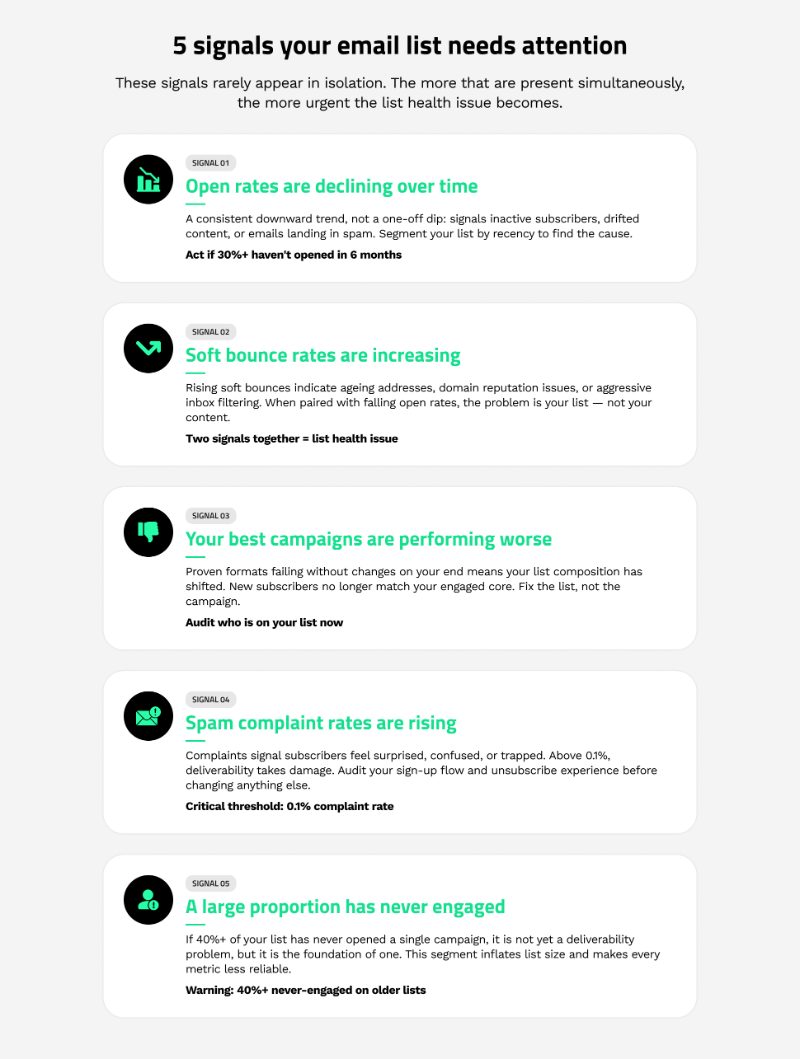
Signal 1: Open rates are declining over time
A single low open rate is not a pattern. A consistent downward trend across multiple campaigns over several months is.
Declining open rates usually mean one of three things: a growing segment of inactive subscribers is dragging the average down, your subject lines and send frequency have drifted away from what your audience expects, or your deliverability has shifted and emails are landing in spam or promotions for more recipients than before.
Diagnosing which one requires segmenting your list. Pull out subscribers who have not opened in 90 days, 6 months, and 12 months and look at the size of each group. If 30% or more of your list has not opened in six months, the inactive segment is your primary issue.
Signal 2: Soft bounce rates are increasing
Hard bounces are permanent delivery failures: the address does not exist. Soft bounces are temporary: the address exists but the email could not be delivered at that moment.
A small number of soft bounces is normal. A consistent increase is a signal worth investigating. It can mean that addresses in your list are becoming inactive or abandoned, that domain-level reputation is starting to affect delivery, or that you are sending to addresses that have never fully engaged and inbox providers are starting to filter more aggressively.
When soft bounces increase alongside declining open rates, the two signals together suggest a list health issue rather than a content or timing issue.
Signal 3: Your best campaigns are performing worse than they used to
If a format, subject line style, or send time that reliably performed well has stopped working, without any obvious change on your end, the audience has shifted.
The most common cause is list composition change. You have added subscribers who do not match the profile of your engaged core, either through different acquisition channels, broader targeting, or time passing and the original audience aging out of active engagement.
The fix here is not to find a new best campaign. It is to understand the composition of your current list and whether your content is still aligned with who is on it.
Signal 4: Spam complaint rates are rising
Even a small increase in spam complaints is significant. Inbox providers treat complaint rates seriously and a rate above 0.1% can start affecting deliverability at scale.
Spam complaints are usually a permission signal. Subscribers complain when they receive something they did not expect, do not recognise, or cannot easily unsubscribe from. The unsubscribe link being buried, the from name being unclear, or emails arriving at a frequency higher than expected are common causes.
If complaint rates are rising, audit your sign-up process and your unsubscribe experience before changing anything else.
Signal 5: A large proportion of your list has never engaged
This one is less visible but often the most important. If you pull engagement data and find that a significant portion of your list, sometimes 40% or more in older lists, has never opened a single campaign, that is not a deliverability problem yet. But it is the foundation of one.
A never-engaged segment drags down every average you track. It inflates your list size without contributing to results. And as that segment grows as a proportion of your overall list, it progressively makes your performance data less useful.

What to do when you spot these signals
The actions follow from the signals:
- Segment your list by engagement level. Active, recently lapsed, lapsed, and never engaged are the four categories worth separating.
- Run a re-engagement campaign to the lapsed segment before removing anyone. Give them a clear reason to stay and a clear path to leave. The ones who engage are worth keeping. The ones who do not should be removed.
- For the never-engaged segment, consider whether a re-engagement attempt is appropriate or whether removal is the cleaner path.
- Check your sign-up process for anything that is adding low-quality subscribers: pre-checked boxes, unclear offers, or lead magnets that attract people who have no interest in what you actually send.
- Run a List Health Check on your current list before your next major send. Understand what is in your audience before you continue building campaigns on top of it.
The goal is not a smaller list for the sake of it. The goal is a list where the data you have is actually telling you something useful, and every send is going to people who have a reason to care.
That is where better results come from.
Explore further about Content Marketing article here.

A comprehensive guide to open rates
Better open rates usually translate to better click-through rates, but now you see your open rates are declining. What do you do? This article will unpack the science behind email open rates and he...

Maximising email engagement: Strategies and tactics
Every marketer knows that sending emails is still a great way to reach people. But without the right tricks under your belt, it can be more difficult to engage your subscribers than it needs to be....

9 tactics to get more leads using email marketing
If you’re feeling a bit stuck as an email marketer, it may be time to review and revise your lead generation tactics. This article discusses why you should focus your energy on lead generation an...
Explore further about Content Marketing article here.
A comprehensive guide to open rates
Better open rates usually translate to better click-through rates, but now you see your open rates are declining. What do you do? This article will unpack the science behind email open rates and he...
Maximising email engagement: Strategies and tactics
Every marketer knows that sending emails is still a great way to reach people. But without the right tricks under your belt, it can be more difficult to engage your subscribers than it needs to be....
9 tactics to get more leads using email marketing
If you’re feeling a bit stuck as an email marketer, it may be time to review and revise your lead generation tactics. This article discusses why you should focus your energy on lead generation an...
A comprehensive guide to open rates
Better open rates usually translate to better click-through rates, but now you see your open rates are declining. What do you do? This article will unpack the science behind email open rates and he...
A comprehensive guide to open rates
Better open rates usually translate to better click-through rates, but now you see your open rates are declining. What do you do? This article will unpack the science behind email open rates and he...
Maximising email engagement: Strategies and tactics
Every marketer knows that sending emails is still a great way to reach people. But without the right tricks under your belt, it can be more difficult to engage your subscribers than it needs to be....
9 tactics to get more leads using email marketing
If you’re feeling a bit stuck as an email marketer, it may be time to review and revise your lead generation tactics. This article discusses why you should focus your energy on lead generation an...
Still haven't found what you are looking for?
Book a demo with us and see Mail Blaze in action, or reach out to our support team for expert assistance. We're here to help you every step of the way!
Still haven't found what you are looking for?
Still haven't found what you are looking for?
Book a demo with us and see Mail Blaze in action, or reach out to our support team for expert assistance. We're here to help you every step of the way!
Book a demo with us and see Mail Blaze in action, or reach out to our support team for expert assistance. We're here to help you every step of the way!
2025 © Mail Blaze. All rights reserved.