


Content Marketing | 5 min read
Content Marketing | 5 min read

There is a client I have been watching for a while. He sends email campaigns through our platform, to a list, on a schedule. By every technical definition, he is doing exactly what every other email marketer is doing. But his emails feel different. When one lands in your inbox, your first instinct is not this is marketing. Your first instinct is that he sat down and wrote it to you.
He didn't, of course. He wrote it once, to everyone. But that is exactly the point.
The gap between emails that feel personal and emails that feel like campaigns is not a technical one. It is not about personalisation fields or dynamic content blocks, (although those things help.) It is about a set of decisions that happen before anyone opens a builder or hits send. Decisions about voice, about specificity, about what the email is actually trying to do for the person reading it. Here is what separates one from the other, and how to close that gap in your own campaigns.
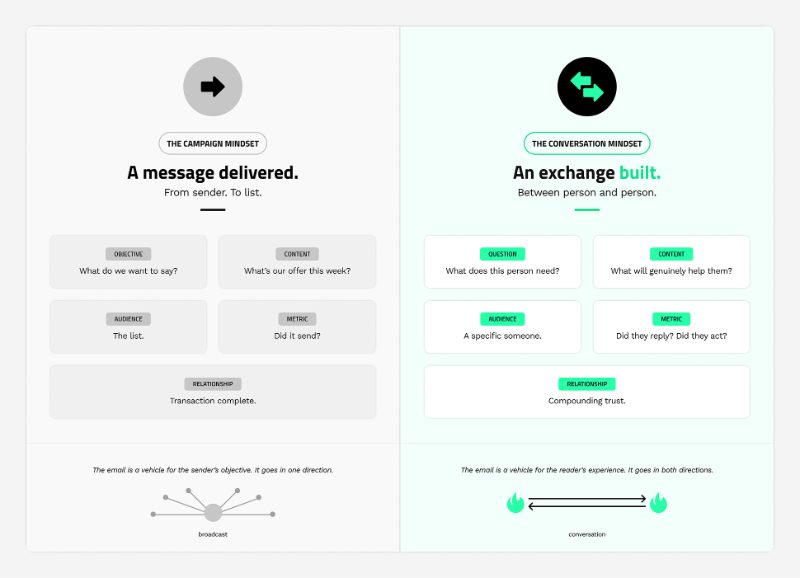
The campaign mindset vs the conversation mindset
Most email marketing is built around a campaign mindset. There is a message to deliver, a product to promote, an announcement to make. The email is a vehicle for that message. It goes from the sender to the list.
The emails that feel personal are built around a different question: what does this specific person need to know, think, or feel after reading this? The email is a vehicle for the reader's experience, not the sender's objective. This sounds like a subtle distinction. In practice it changes almost everything: what you lead with, how you write the body, what you ask the reader to do, and whether you sound like you're talking to them or at them.
The client I mentioned earlier almost never leads with what he wants the reader to do. He leads with something the reader is already thinking about. Since he’s in the home decor and gifting space, he often taps into the fear and frustration people have when trying to find a lovely personalised gift. This is a problem they have, a question they are sitting with, an observation about something happening in their world. The ask comes later, almost incidentally, once he has already made the reader feel understood. It works, really well.
Specificity is the shortcut to feeling personal
Generic language signals a generic audience. When an email could have been sent to anyone, it feels like it was.
The fastest way to make an email feel personal is to be specific. Not as business owners, you know how difficult it can be to find time for marketing but if you sent a campaign last week and you're not quite sure how it performed, this is for you. One statement could apply to millions of people. The other conjures a very specific person in a very specific moment.
Specificity does not require knowing personal details about each subscriber. It requires knowing your audience well enough to describe their situation accurately. When a reader sees their exact circumstances reflected back at them, the email stops feeling like a broadcast and starts feeling like a conversation. This is where segmentation earns its value. Not as a technical exercise, but as a way of being more specific to more people. A segment of subscribers who joined in the last 30 days has different needs, questions, and levels of familiarity than a segment who have been on your list for two years. An email written for one will feel slightly off to the other. An email written for both will feel off to everyone.
Write the way you speak, not the way you write
Read your last campaign out loud. All of it. From the subject line to the sign-off. Does it sound like you? Or does it sound like someone trying to write a professional email?
The emails that feel personal are almost always written in a voice that sounds like a real person speaking. Short sentences. Occasional incomplete thoughts. A sense of rhythm that comes from someone who knows what they want to say and is just saying it, not constructing it.
This is harder than it sounds. Most people write more formally than they speak, especially when they know the email is going to hundreds or thousands of people. The audience size creates a kind of self-consciousness that makes the writing stiffer, safer, and less personal.
One exercise that helps: write the email as if you are writing to one specific person. Not a subscriber. A real person you know who fits your audience. Write to them. Then take their name out. What's left will almost always read more naturally than anything you would have written to your subscribers.
What to do with the insight rather than just the information
Most campaigns deliver information. The personal-feeling ones deliver insight.
Information:
open rates are declining across the industry.
Insight:
open rates are declining across the industry, and the senders holding their rates are the ones who trained their audience to expect something worth opening.
Here's what that actually looks like.
The first tells the reader something. The second gives them something to think about, a frame to apply to their own situation, a reason to read on. It respects their intelligence and their time in a way that raw information delivery doesn't. This is the piece that is hardest to automate or template. It requires having a genuine point of view on what you know. It is also the piece that makes people say the email felt like it was written for them, even when it wasn't.
The test
Before you send your next campaign, read it once and ask: does this sound like something I would say to someone I respect, or does it sound like something I wrote because I needed to send an email? If it's the latter, it's worth another pass. Not a complete rewrite. Just enough to find the one line that sounds most like you, and let that line set the tone for everything around it.
Mail Blaze feature highlight: Personalisation in Mail Blaze
- Mail Blaze gives you the tools to make personalisation practical, not just possible.
- Segmentation lets you divide your list based on behaviour, engagement level, sign-up source, or any custom field, so the right email reaches the right people. A subscriber who opened every email in the last 90 days deserves different content to one who hasn't opened in six months. Sending both the same campaign is the fastest way to feel impersonal to both of them.
- AI content blocks can help you develop and vary your copy, generate subject line options, and refine your tone while keeping your voice at the centre. It is a thinking partner, not a replacement for your perspective.
- The drag and drop builder makes it easy to structure emails that lead with the reader's experience: a strong opening, a clear idea, a specific ask. Good structure is part of what makes an email feel considered rather than assembled.
Explore further about Content Marketing article here.

The email marketers periodic table of elements
Learn all about email marketing by taking a closer look at all the elements involved in the email marketing journey.

Create a survey with Mail Blaze
Learn how to create your own customer surveys using Mail Blaze

Maximising email engagement: Strategies and tactics
Every marketer knows that sending emails is still a great way to reach people. But without the right tricks under your belt, it can be more difficult to engage your subscribers than it needs to be....
Explore further about Content Marketing article here.
The email marketers periodic table of elements
Learn all about email marketing by taking a closer look at all the elements involved in the email marketing journey.
Create a survey with Mail Blaze
Learn how to create your own customer surveys using Mail Blaze
Maximising email engagement: Strategies and tactics
Every marketer knows that sending emails is still a great way to reach people. But without the right tricks under your belt, it can be more difficult to engage your subscribers than it needs to be....
The email marketers periodic table of elements
Learn all about email marketing by taking a closer look at all the elements involved in the email marketing journey.
The email marketers periodic table of elements
Learn all about email marketing by taking a closer look at all the elements involved in the email marketing journey.
Create a survey with Mail Blaze
Learn how to create your own customer surveys using Mail Blaze
Maximising email engagement: Strategies and tactics
Every marketer knows that sending emails is still a great way to reach people. But without the right tricks under your belt, it can be more difficult to engage your subscribers than it needs to be....
Still haven't found what you are looking for?
Book a demo with us and see Mail Blaze in action, or reach out to our support team for expert assistance. We're here to help you every step of the way!
Still haven't found what you are looking for?
Still haven't found what you are looking for?
Book a demo with us and see Mail Blaze in action, or reach out to our support team for expert assistance. We're here to help you every step of the way!
Book a demo with us and see Mail Blaze in action, or reach out to our support team for expert assistance. We're here to help you every step of the way!
2025 © Mail Blaze. All rights reserved.